Showing posts with label horse racing. Show all posts

Sunday, December 1, 2013

Germany's new stallion Maxios has maximum sire potential in his genes

It was announced today that Germany’s Gestut Fahrhof will stand an exciting new stallion in 2014: the Niarchos Family’s British-foaled Maxios, a quality racehorse and exquisitely bred son of Monsun who will cover mares for €10,000.

At two in 2010, Maxios won a debutant maiden race at Longchamp and the Group 3 Prix Thomas Bryon, his only starts that season and both over a distance of eight furlongs. He followed up on his promising start with a forgettable three-year-old campaign, in which he ran off the board in four-of-four starts -- a Group 3, Group 2, and two Listed events, from ten to 13 furlongs.

Returning at four, Maxios won half of his six starts, including the ten-furlong La Coupe de Maisons-Laffitte-G3, and was placed second in the 12-furlong Grand Prix de Chantilly-G2. His breakout year was 2013, when as a five-year-old he won two Group 1s: the Prix d’Ispahan (nine furlongs) and the Prix du Moulin de Longchamp (eight furlongs). He also won the ten-furlong Prix d’Harcourt-G2 and was second in the 11-furlong Prix de Ganay-G1.

Maxios’s sire Monsun (by Konigsstuhl) passed away in September of 2012 -- less than a week before Maxios’s Prix du Moulin win -- having made an indelible mark on the international racing industry with 98 stakes winners, equating to 14% of his foals. Where such a high percentage was once expected of top sires in the 1980s and 1990s, stakes-winners-to-foals figures in the teens is, without getting too involved in the discussion, a rarity with today’s breeding practices.

[As an aside, notable sires who stood in the ’80s and ’90s and up to the 2000s include: Northern Dancer (23% stakes winners), Blushing Groom (18%), Danzig (18%), Nijinsky II (18%), Nureyev (17%), Roberto (17%), Mill Reef (16%), Mr. Prospector (15%), Danehill (14%), Native Dancer (14%), Lyphard (13%), Riverman (13%), Sadler’s Wells (13%), Acatenango (12%), A.P. Indy (12%), Caerleon (12%), Caro (12%), Sir Tristram (12%), Storm Cat (12%), Alydar (11%), Sunday Silence (11%), Alleged (10%), Darshaan (10%), Kris S. (10%), Rainbow Quest (10%), Seattle Slew (10%), Irish River (9%), Konigsstuhl, (9%), Machiavellian (9%), Linamix (8%), Deputy Minister (8%), Halo (8%), Miswaki (8%), Montjeu (8%), Unbridled (8%), Zabeel (8%), etc. **This list is off the top of my head and not meant to be comprehensive!!**

Comparing Monsun’s figure of 14% to some top active sires of 2013, we find War Front, currently with 27 black-type stakes winners, at 11%; Distorted Humor, 10% (114 stakes winners); Speightstown, 10% (53); Dubawi, 9% (64); Galileo, 9% (154); Dansili 9% (86); Oasis Dream, 9% (74); Redoute’s Choice, 8% (108); Smart Strike, 8% (93); Deep Impact, 7% (37); Giant’s Causeway, 7% (136); Kitten’s Joy, 7% (41); Tapit, 7% (44); Unbridled’s Song, 7% (99; not an active stallion but included here because he has some crops yet to race); Awesome Again, 6% (53); Exceed and Excel, 6% (75); More Than Ready, 6% (120); and Fastnet Rock, 5% (52).]

All this is is a long-winded way of pointing out that Monsun, who stood at Gestut Schlenderhan, was an exceptional, very significant sire, although comparing the restrictive German market with the far broader English, Irish, and North American markets probably gives Monsun a bit of an advantage. Either way, 14% is major and Monsun left us with some decent sire sons in Samum, who has sired four Group 1 winners, and Manduro, with two winners at that level from three crops of racing age. Shirocco is also doing well, with 2013 British Group 2 winner Brown Panther.

Maxios comes from a powerful female family: his dam Moonlight’s Box is an unraced (due to a pelvis injury) daughter of Nureyev and French highweighted filly Coup de Genie, who won the Prix Morny-G1 and Prix de Salamandre-G1 against colts. Moonlight’s Box is also the dam of Prix de l’Arc de Triomphe winner Bago (by Nashwan), a sire in Japan; and Listed stakes winner Beta (by Selkirk), a broodmare.

Coup de Genie with her first foal, the Nureyev filly Moonlight's Box.
Second dam Coup de Genie (by Mr. Prospector) produced four stakes winners: Denebola-G1 (by Storm Cat), Snake Mountain-G3 (by A.P. Indy), Loving Kindness-G3 (by Seattle Slew), and Glia (by A.P. Indy). Glia is the granddam of Emollient (by Empire Maker), who won three Grade 1 races in 2013.

Moonlight’s Box (aged 17 years) and Coup de Genie (22) are still actively producing -- each is the dam of a yearling filly by Galileo.

Coup de Genie is a full sister -- out of Group 3 winner Coup de Folie -- to champion Machiavellian, who like Coup de Genie won the Morny and the Salamandre; and Group 3 winner Ocean of Wisdom. Another full sister Houdini’s Honey was a winner and has produced two stakes winners, one graded, to date. Exit to Nowhere, an Irish River half-brother to Coup de Genie et al, won the Prix Jacques Le Marios-G1, and their half-sister Hydro Calido (by Nureyev) was a Group 2 winner and stakes producer. (There are three Thomas Bryon winners within the first three generations of Maxios’s family: Maxios, Nureyev, and Exit to Nowhere.) Machiavellian was a 9% sire with 71 stakes winners, including Street Cry (sire of U.S. Horse of the Year Zenyatta) at the forefront of his 13 Group 1/Grade 1 winners. Exit to Nowhere sired six group winners before his death in October of this year.

Machiavellian at Dalham Hall Stud in England in 1997.
Coup de Folie, the third dam of Maxios, was by Halo out of Raise the Standard (by Hoist the Flag), making her inbred 3x3 to Almahmoud (granddam of Halo and Raise the Standard). More significantly, Raise the Standard was a daughter of Natalma and thus a half-sister to Northern Dancer. Another direct female-line descendant of Natalma was the sensational sire Danehill (inbred 3x3 to Natalma, the granddam of his parents Danzig and Razyana). The dam of leading sire Halo was a half-sister to Natalma.

Monsun sired 14 stakes winners, including Maxios, out of mares from Northern Dancer’s male line. It will be especially interesting to see the result of Danehill-line mares crossed with Maxios. Monsun has four stakes winners (by either him or his sons) out of mares from the Danehill male line, and Maxios’s close relative Machiavellian has 15 stakes winners (all by his sons) -- including Melbourne Cup-G1 winner Shocking; Siyouma-G1; Nannina-G1; and December Draw-G1 -- bred on this cross.

Bago’s best foal is Big Week, Classic winner of the Kikuka Sho-G1 (Japanese St. Leger). Big Week was produced from a daughter of Sunday Silence -- whose sire Halo is from the same female family as Bago and Maxios.

Between Danehill, Northern Dancer, Halo, and even perhaps Machiavellian and Exit to Nowhere, there are many possibilities to tap into the quality in Maxios’s female family. Per a news item in the Racing Post, the Niarchos Family, who bred and raced most of Maxios’s above-mentioned relatives as far back as Nureyev and Coup de Folie -- either under the Niarchos name or nom de course Flaxman Holdings -- looks to be moving in that direction after purchasing French Group 1 five- and six-furlong specialist Gilt Edge Girl (her sire Monsieur Bond is a paternal grandson of Danehill) for €550,000 at Goffs in November, with intention of breeding her to Maxios.

Tuesday, November 8, 2011

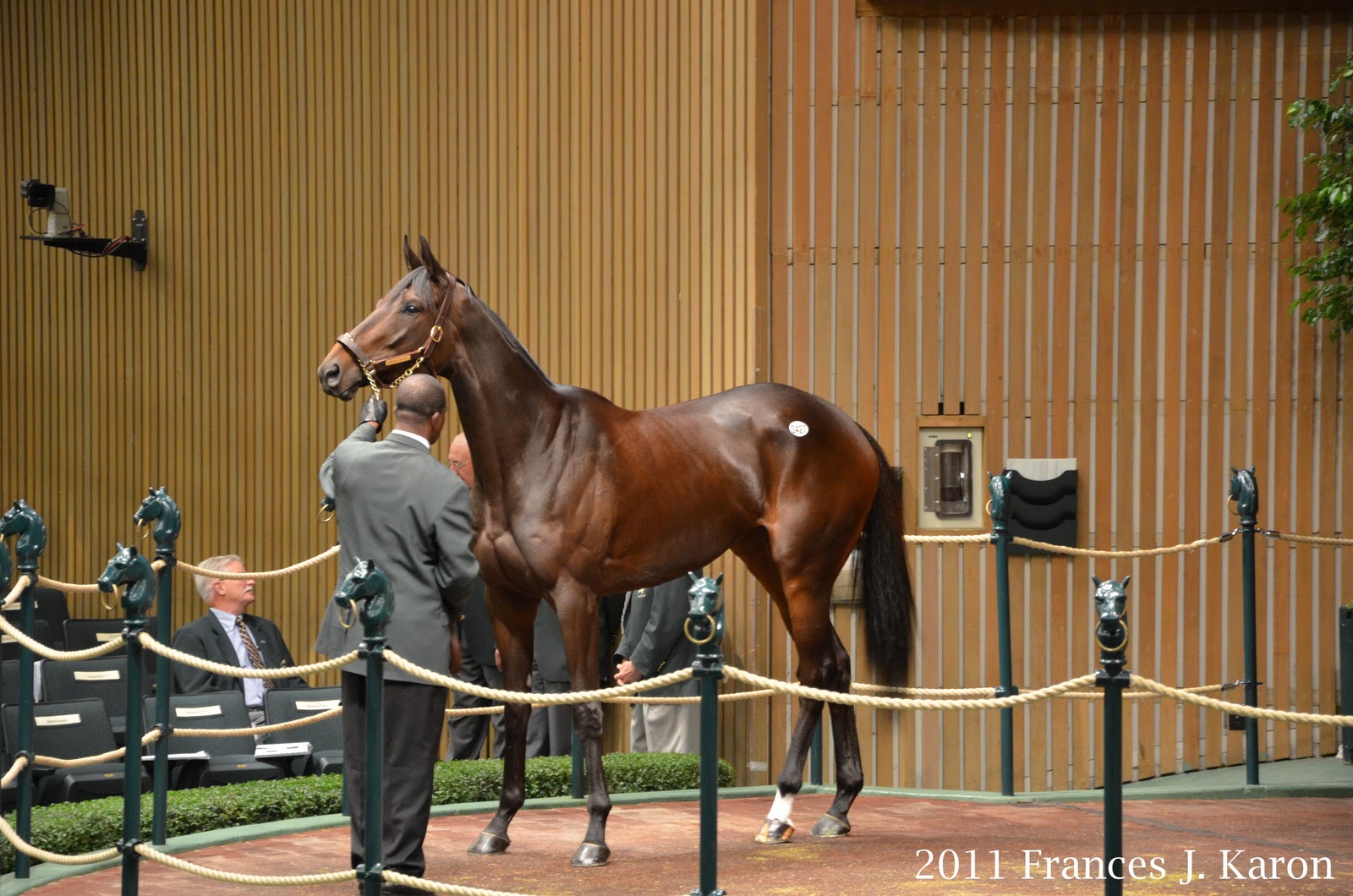
Royal Delta at Keeneland

Breeders’ Cup Ladies Classic winner Royal Delta sold through Chanteclair Farm for $8,500,000 to Ben Leon’s Besilu Stables at Keeneland this afternoon. Besilu has horses with Todd Pletcher, so there’s speculation that she may be transferred from trainer Bill Mott’s barn to Pletcher to continue her racing career. For owner/breeder Palides Investments N.V., Inc. and Mott, the four-year-old daughter of Empire Maker and Delta Princess also won the TVG Alabama S.-G1, Black-Eyed Susan-G2, was second in the Beldame Invitational S.-G1, and third in the TVG Coaching Club American Oaks-G1.


Monday, October 24, 2011

Havre de Grace at Keeneland

This morning, Fox Hill Farms’ Horse of the Year candidate Havre de Grace breezed at Keeneland in preparation for the Breeders’ Cup Classic against the colts at Churchill Downs on Saturday, November 6th.

It was my first time seeing the four-year-old filly, and I was impressed by her professional attitude and the ease and fluidity of her long stride. She covered five furlongs in :58 3/5, the second fastest of 14 horses to work the distance on the day.

Cindy Jones, wife of trainer Larry, leads Havre de Grace on to the track.

Galloping around the turn well in hand before beginning her timed work.

The second time around, breezing, under jockey Gabriel Saez.

She really stretches out.

Coming off the track after the breeze.

Tuesday, October 11, 2011

A few more shots from Keeneland

Stakes-placed Rescue Squad coming off the track after morning training.
Above and below, breeder/owner/trainer Bart Evans shows his affection for his multiple Graded stakes-winning mare Wasted Tears ($941,463).


Barbara the horse identifier reading a lip tattoo in the paddock.

Here Comes Frazier, the Kenny McPeek-trained colt who swerved into the rail and catapulted rider Julien Leparoux clear over the rail, when a Bourbon Stakes victory was within his grasp.

Flaxman Holdings' Aruna, trained by Graham Motion, minutes before winning the Spinster.

Protesting, granddaughter of My Flag and great-granddaughter of Personal Ensign, on her toes before the Spinster as jockey Johnny V, trainer Shug McGaughey, and assistant trainer Buzz Tenney look on.

Protesting, protesting.

Spinster winner Aruna leading second-place finisher Pachattack down the stretch.

The Spinster finish, from Aruna in first to the gray Tapitsfly in last.

Friday, October 7, 2011

Photos from Keeneland's opening day

I took waaay too many photos, but here are some of my favorites from opening day at Keeneland:

Johnny V prepares to hop on Stephanie's Kitten on their way to winning the Grade 1 Darley Alcibiades S.

The outrider ponied the 7 horse, Second Street City, from the paddock for the 4th. The three-year-old filly subsequently won the race.

Millionaire and two-time Grade 1 winner Switch is STUNNING.

Aikenite, Grade 2 winner.

Take Charge Indy, entrant in Saturday's Grade 1 Dixiana Breeders' Futurity. He's a son of Take Charge Lady, who won two Grade 1s at Keeneland.

Snow Top Mountain, Keertana's stakes-winning younger half-sister. 

He's out of focus but I still love this picture of Ron McAnally with his Grade 1 winner Eclair de Lune.

Billy Koch of Little Red Feather Racing loves on Egg Drop as she gets saddled for the Grade 1 Darley Alcibiades.

It's opening day of the fall season at Keeneland

Just one hour away until Keeneland kicks off its’ 75th anniversary fall meet!

Fall barn scene at Keeneland.

Two-year-old filly Tu Endie Wei has made the trek from Canada to run in today's Grade 1 Darley Alcibiades S. Trained by Reade Baker, she is 2-for-2, both stakes wins.
Tu Endie Wei.
Group 3 winner Theyskens' Theory (trained by Shug McGaughey), cross-entered in the G1 First Lady S. on Saturday and the G1 Spinster S. on Sunday.
Wasted Tears (Bart Evans) grazing the day before her scheduled start in the G1 First Lady S.
Together (a daughter of Galileo), over from Ireland for Aidan O'Brien. The three-year-old finished second in two Classics this year, the English 1,000 Guineas and Irish 1,000 Guineas. She, too, runs in the First Lady on Saturday.
Shotgun Gulch, winner of April's Grade 1 Vinery Madison S., switching leads on the track at Keeneland. Oklahoman C.R. Trout bred, owned, and trains this filly, who runs in the Thoroughbred Club of America S.-G2 on Saturday.
Aruna (trained by Graham Motion) galloping at Keeneland. She runs in the G1 Spinster S. on Sunday.
Aruna.
Pachattack, European filly who was 2nd in the Grade 1 Personal Ensign H. at Saratoga in her last start. The Gerard Butler-trainee starts in the G1 Spinster.
Grade 2 winner Well Monied, another Spinster entrant, is in town from California for trainer Howie Zucker.
Random horses working in tandem over the training track.

Thursday, July 28, 2011

Allegretta, Racing's Great Seductress

“She was a useful race filly who gave the impression of not having much heart…but she descended from an exceptional family…I went to look at her. She is not elegant, but she has an exceptional body. I was seduced.”

Allegretta in 1997.
These were the words of Michel Henochsberg, told to Paris-Turf and relayed by John P. Sparkman in a 2001 Thoroughbred Times pedigree profile on Allegretta (GB) (1978-2005). 

As Sparkman wrote in his profile – a must-read for racing history and pedigree buffs – Asterblute, the fifth dam of Allegretta, was sired in Germany by Pharis II in 1946, during the stallion’s last of five years as a Nazi captive. 

Gestut Schlenderhan bred and raced Asterblute, winning the German Derby and German Oaks with her, and cultivated the female line that resulted in the birth of Allegretta in England in 1978. (Allegretta was the first of her direct line to be foaled outside of Germany.) Because of the dodgy circumstances surrounding Pharis’s acquisition by the Nazis, the international stud book outside of Germany didn’t recognize Asterblute and her line until the 1970s, when Pharis’s owner/breeder Marcel Boussac allowed a number of his stallion’s German-bred progeny to be legitimized. 

Horses don’t come much more stoutly-bred than Allegretta. Her sire Lombard was a German St. Leger winner and two-time Horse of the Year in Germany, divisional champion at two, four, five, and six. He was by German St. Leger winner Agio, a son of 1950-1951 Prix de l’Arc de Triomphe winner Tantieme. (Tantieme is found in North American and European pedigrees through the full brothers Diesis and Kris). Belle Sauvage, the second dam of Lombard, was also the second dam of 1968 Arc winner Vaguely Noble. 

In 15 crops, Lombard sired 214 foals, 14 of them stakes winners. Allegretta was not among these fourteen, although her full siblings Anno (first in the German St. Leger) and Arionette were. Trained in England by Sir Michael Stoute, she won two-of-three starts at two and placed second in the Group 3 Oaks Trial at three. 

Late in her three-year-old season, Allegretta went through the sales ring at Tattersalls and was sold to American interests. Imported to the U.S., she was bred the following year but failed to get in foal. She returned to the racetrack, running exclusively in sprints (for which she was clearly not bred) at Suffolk Downs in Massachusetts, making her four-year-old debut in the autumn for Big E Farm and trainer Bruce G. Smith and finishing sixth. She was third and seventh in her subsequent starts. 

She was retired again and covered in 1983, resulting in a second barren year. When, during her third season at stud, she conceived to the cover of Irish Castle, Big E understandably wanted to cut their losses on her and sold Allegretta in the 1984 Keeneland November sale, where Robert Nataf of Horse France purchased her for $55,000 on behalf of Marystead. 

She had been culled by Schlenderhan; sold by Big E after numerous unproductive years; but for Marystead (who also breeds under M3 Elevage), Allegretta was to become one of the most influential broodmares of our time. 

One interesting aspect of Allegretta’s bloodline is that her fifth dam Aster (dam of Asterblute) was also granddam of Lombard’s sire Agio, reinforcing this strong female family with Aster 4x5 in Allegretta’s pedigree. Allegretta was also 4x4 to German Derby winner Alchimist. 

Lombard’s daughters produced just twelve stakes winners. Allegretta foaled three of them. Here is her produce record:

1983 not pregnant
1984 not pregnant
1985 Marlene Kelly, f. by Irish Castle; winner 
1986 Anzille, f. by Plugged Nickle; placed; stakes producer 
1987 Irish Allegre, g. by Irish River (Fr); winner 
1988 Shadideen, g. by Shadeed; winner 
1989 URBAN SEA, f. by Miswaki; Group 1 winner; stakes producer 
1990 Turbaine, f. by Trempolino; stakes-placed winner; stakes producer 
1991 ALLEZ LES TROIS, f. by Riverman; Group 3 winner; stakes producer 
1992 Oslo Connection, c. by Trempolino; placed 
1993 Albada, g. by Houston; winner 
1994 no report 
1995 Saleela, f. by Nureyev; winner 
1996 not pregnant
1997 KING’S BEST, c. by Kingmambo; Group 1 winner 
1998 no report 
1999 Altruiste, f. by Diesis (GB); unraced; stakes producer 
2000 not pregnant
2001 not pregnant

King’s Best – one of just two colts out of the temperamental Allegretta who wasn’t gelded – was lightly raced, winning three-of-six starts in England. Trained, like his mother, by Stoute, he won the Listed Acomb Stakes at two and the 2,000 Guineas at three. He was injured in the running of his next start, the Irish 2,000 Guineas, and subsequently retired under the Darley Stud banner, where he his six G1 winners include Workforce, who won the 2010 Epsom Derby and Arc, and last year’s Japanese Derby victor Eishin Flash.

Allegretta and King's Best as a foal.
Criquette Head-Maarek trained Allez les Trois to score three wins, including the Prix de Flore-G3, in France. The filly later placed in the Grade 3 Saratoga Breeders’ Cup Handicap when trained in the U.S. by Christophe Clement. Her first foal was Prix du Jockey Club-French Derby winner Anabaa Blue, one of her three stakes winners to date. She is also granddam of two-time Group 1 winner Tamayuz.

Allegretta's daughter Allez Les Trois.
Globe-trotting Urban Sea, trained by Jean Lesbordes, ran in France, Germany (where she was third in the 1,000 Guineas), England, Japan, Canada, and the U.S. All seven of her stakes wins came in France, highlighted by her victory in the 1993 Arc. 


Yet Urban Sea went on to greater fame and fortune. At stud, she produced eleven foals, seven of them stakes winners, six at Group or Graded level: Sea the Stars-G1, Galileo-G1; My Typhoon-G1; Black Sam Bellamy-G1; All too Beautiful-G3; and Urban Ocean-G3. She died in 2009. Her final foal is a two-year-old son of Invincible Spirit named Born to Sea, for the Sea the Stars connections – owner/breeder Christopher Tsui and trainer John Oxx. 

Of the European Broodmare of the Year’s four daughters, the only two with foals of racing age to date are All too Beautiful, dam of this year’s Cheshire Oaks [L] winner Wonder of Wonders, who was placed in the Epsom Oaks and the Irish Oaks; and Melikah, granddam of 2011 U.A.E. Derby-winning filly Khawlah. 

Urban Sea’s European Horse of the Year son Sea the Stars received a Timeform rating of 140 – placing him on a par with Dancing Brave, Dubai Millennium, Shergar, and Vaguely Noble. He lost only the first of his nine lifetime starts, scoring emphatic victories in all six of his Group 1 races as a three-year-old: the Arc, English 2,000 Guineas, Epsom Derby, Eclipse, International, and the Irish Champion. He became only the second foal of a female Arc winner to follow in his dam’s footsteps. (Detroit and Carnegie were the first mother-and-son Arc winners.) Retired to stud in Ireland, Sea the Stars’s first foals were born this year. 


Sea the Stars will have a long way to go to emulate the stud career of his 13-year-old half-brother Galileo. 

Galileo was European champion three-year-old after winning the Epsom Derby, the Irish Derby, and the King George VI & Queen Elizabeth Diamond Stakes. His two losses in eight starts came at the end of his career, when he was second in the Irish Champion and unplaced in the Breeders’ Cup Classic at Belmont. 


Surely, Galileo is the best proven Thoroughbred stallion at stud in the world. In his current three-year-old crop, he’s the sire of European Classic winners Frankel (2,000 Guineas); Golden Lilac (Poule d’Essai des Pouliches-French 1,000 Guineas and Prix de Diane); Misty for Me (Irish 1,000 Guineas); Roderic O’Connor (Irish 2,000 Guineas); and Treasure Beach (Irish Derby). His Nathaniel won last weekend’s King George VI & Queen Elizabeth S.-G1 over Workforce. Many racing luminaries are hailing Frankel as the possibly best ever; Timeform has the undefeated colt, who on July 27th won the Group 1 Sussex Stakes against older horses with a chilling turn of foot, rated at 142, the greatest since Brigadier Gerard (144), a foal of 1968. Only Sea-Bird (145), Tudor Minstrel (144), and the Brigadier are rated higher than Frankel, who may yet improve his figure.


Other Galileo flagbearers this month are four-year-olds Cape Blanco, who won the Man o’ War Stakes (and last year’s Irish Derby), and the filly Igugu, winner of the prestigious Grade 1 Durban July over colts. 

If Allegretta “gave the impression of not having much heart,” the same cannot be said for many of her sons, daughters, and their progeny. And 33 years after her birth, the grand old mare continues to “seduce” those of us who follow horseracing, with the likes of Frankel, Sea the Stars, and Galileo, who will hopefully continue to sweep us off our feet for many generations to come.

Tuesday, January 4, 2011

Some Thoughts On the Eclipse Awards, and My Votes

When I became a member of the National Turf Writers Association (now the National Turf Writers and Broadcasters, or NTWAB) in 2009, there was a delicious thrill at the prospect of participating in the voting for the Eclipse Awards. Having been in love with horseracing for almost as far back as I can remember, it was a personal achievement to have ‘made it,’ if you will.

My excitement last year quickly fizzled in the ensuing ugliness that erupted in the Rachel Alexandra vs. Zenyatta debate. I use the word “debate” out of politeness; my experience was not pleasant, and the verbal attacks I received and witnessed against both sides is not something I want to go through again, ever. My philosophy is this: I respect your right to have an opinion within reason, and in return I ask that you respect my right to have an opinion within reason. I couldn’t tell anyone who argued for either Rachel Alexandra or Zenyatta as 2009 Horse of the Year that their opinion was “wrong,” just as I wouldn’t do that to anyone who opts for Blame or Zenyatta this year. I stand behind and wholly support my candidate, which means that I’m not going to insult anyone’s intelligence by hitting them over the head with my opinion. I’ve learned that that approach has a counterproductive effect, and being respectful of each other’s opinion should not be too much to ask.

There are those who think the Eclipse Awards are meaningless, a dinosaur, that their chief purpose is to enhance stud fee values or the like. Me, well, I believe it is an honor to have one’s achievements recognized in an industry where we have bred pure-blooded horses for hundreds of years in the quest for a superior animal. Claiborne Farm imported Rough Shod (for whom this blog is named) to the United States circa 1951, and from her the Hancock family nursery bred Thong, Thong’s daughter Special, Special’s daughter Bound, Bound’s daughter Liable, and Liable’s son Blame. You can bet that breeding a horse such as Blame from a mare purchased 60 years and five equine generations ago is a pretty big deal to Claiborne – for whom I voted, along with Blame’s co-breeder/co-owner Adele B. Dilschneider, as leading breeder. They have invested 60 years into cultivating the Rough Shod family; do you honestly think an Eclipse Award is meaningless to them?

I worked at Walmac Int’l in 1997, when 2-year-old Favorite Trick was named Horse of the Year. Walmac stood Favorite Trick’s sire Phone Trick and had bought an interest in Favorite Trick early in his juvenile season, so it was doubly meaningful. When that gold statuette – a duplicate of the original, which principal owner Joe LaCombe kept – arrived at the farm, it was…wow!…beautiful. To pick it up and hold it gave me a tangible understanding of what it’s all about. That Horse of the Year statue was placed in the office of Walmac owner and general manager Johnny T.L. Jones Jr. (Sid Fernando has a post on Johnny here.) Amid the smell of cigars, a collection of Western saddles, and a Remington bronze, paintings of Nureyev and Alleged hung over the fireplace and a portrait of Phone Trick was on another one of the cushioned dark green-paneled walls. A small, framed note handwritten in cursive was displayed so inconspicuously on a narrow strip of wall that one might have missed its importance: a thank you letter from Breeders’ Cup founder John Gaines to Johnny for having broken the ice between disagreeing parties and making the Breeders’ Cup a reality. Favorite Trick’s Horse of the Year award sat on the shelf behind Johnny’s desk, where he and any visitor could easily see it, in front of the window overlooking the mares and foals in the front field on Paris Pike. I don’t know if through the years Johnny still noticed the statuette every single time he went into his office, but I know that I did. Perhaps the memory of how it felt in my hands is why the Eclipse Awards are still important to me; if they weren’t, I couldn’t use my vote.


Horse of the Year Favorite Trick at Walmac in 1998.

I do have some quibbles with the voting process. I question why we are required to list three horses per category – if we fail to do so, our vote will not be counted. The vote is not set up to award, say, five points for a first place vote, three for a second, one for a third; there are no “points” at all, so the only name that counts for anything is in the first field. In many cases, choosing the top horse is simple, and agonizing over who was second- and third-best is not. The killer is that it essentially makes zero difference if I type in Quality Road’s name as second best older male, or if I go with Mine That Bird. If only first place votes are tallied, why the need to rate others? (I am joking about using Mine That Bird, whose best effort this season was a fifth-place finish, to make a point here.)

Another quibble: an award for the sake of an award. The male turf horse category was exceptionally difficult for me this year, not because there was more than one excellent horse, but because there is no clear-cut, truly deserving winner of the 2010 Eclipse. I went back and forth between Gio Ponti and Winchester, and then Paddy O’Prado, and out of frustration very nearly opted for Champ Pegasus. I considered abstaining from the category. In the end I didn’t abstain because someone is going to get the award and I felt like it was my duty to choose; if I had had an option for “no award” I would have taken it.

(I did abstain from the apprentice category; I simply don’t feel I know enough about those young riders to make a qualified decision.)

I would also like to see some of the information on leading owners and breeders laid out differently – not just their totals, but for starters, how many horses did they race or breed that started in the year in question? Obviously, breeding or owning four graded stakes winners from 40 starters is more impressive than eight graded stakes winners from 200 starters.

That there are no guidelines for choosing the best horse is a common complaint against the system, but not for me. I prefer it this way; it gives me a freedom to choose based on whatever criteria in which a horse excelled. Look, I was never into My Little Pony and I promise not to vote for a horse just because it has the prettiest forelock, okay? If the guidelines were “the horse who won the most open Grade 1 races” or “the horse who faced and defeated more Grade 1 winners” or whatever, then a computer may as well calculate the winner. Instead, I get to vote as a person, and as a person who knows what a rush it is to have met the likes of Secretariat, Alleged, Miesque, Affirmed, Forego, Seattle Slew, Nijinsky, Dubai Millennium, John Henry…

And Zenyatta.

Thus, after the long prelude, I arrive at my votes in the equine categories:

2-year-old male:  Uncle Mo
2-year-old female:  Awesome Feather
3-year-old male:  Lookin At Lucky
3-year-old female:  Blind Luck
Older male:  Blame
Older female:  Zenyatta
Sprint male:  Big Drama
Sprint female:  Dubai Majesty
Turf male:  Gio Ponti
Turf female:  Goldikova (this was not as clear-cut for me as one might suppose)
Steeplechase:  Slip Away (this would have been another “no vote” category)
Horse of the Year:  Zenyatta

You are welcome to a different opinion but please – this is not a forum to be hateful or to argue your case (as I myself have refrained from doing).

Friday, October 22, 2010

Old Timers Solid in the Sycamore


Today’s feature at Keeeneland was the Grade 3 Sycamore Stakes over a mile and a half on the Haggin turf course. The race had lost its defending champ, ten-year-old Cloudy’s Knight, when the popular gelding retired this week, but several other old fogies made it into the gate, with the average age of the runners 5.88 years old. The field of twelve had earned over $7.66-million combined (it would have been over $10-million had Cloudy’s Knight run!). I’m posting photos of them in appreciation of these grand old warriors.

The retiree Cloudy's Knight, photographed in November of 2009, a few days prior to his second-place effort by a nose in the Breeders' Cup Marathon..

Brass Hat (1st), a nine-year-old gelding who was registering his first win this season, was the senior citizen of the group, and third betting choice.

Brass Hat in the paddock.

The only horse under the age of five was four-year-old Southern Anthem, who ran second at odds of 54.6-to-1.

Four-year-old Southern Anthem.

The favorite, eight-year-old Musketier (Ger) (3rd), was making his first start since defeating Brass Hat in the Fifth Third Elkhorn S.-G2 over course and distance in April.

Musketier entering the paddock.

Yate’s Black Cat (5th) was one of two seven-year-olds in the field.

Handsome Yate's Black Cat.

The other, three-time Grade 1 stakes winner Presious Passion (9th) – he of the catch-me-if-you-can racing style – was second choice on this, his first appearance on a Kentucky racetrack.

Presious Passion in the paddock...
...and leading the field the first time under the wire.

As you can see, Brass Hat barely broke a sweat in securing the win by a length in 2:30.73.

Brass Hat awaiting win circle photo #2 after winning the Sycamore.

After posing for the traditional graded stakes race winner’s circle photo on the grass course, jockey Calvin Borel did something I’d never seen before when he hopped on the bareback Brass Hat for a win photo in the regular winner’s circle.

Calvin Borel posed bareback on Brass Hat.